About Me

My husband, Sid, and I both teach history in Fayetteville, North Carolina. Sid was awarded a Fulbright lectureship in Japan for the 2010-2011 academic year and so we are moving to Japan with our two (reluctant) boys. :)

Tuesday, September 28, 2010

Yasakuni Jinja

A couple weeks back Sid and I visited the Yasakuni Shrine and I meant to go back and take more pictures but never made it.

Yasakuni Shrine is probably the most controversial "site" here in Tokyo.  It is an old Shinto Shrine (originally built in the 1800s) (Shinto is essentially emperor worship).  This particular shrine is to honor those Japanese killed in war.  It is controversial for two main reasons. First, like America, Japan has the separation of church and state, and so a state-maintained shrine (dedicated to emperor worship) is a hotly debated topic. The other reason that it is so controversial is that it honors all the Japanese war dead, even those condemned as war criminals after World War II.  Many younger Japanese will not visit the shrine and many Americans do not.

It was really interesting to see, though. And, one of the most interesting things to me was the literature in English.  A pamphlet at the shrine said that the original tori (gateway) was replaced because it was damaged in World War II (presumably from the fire bombings). But, the placard in front of the tori said that the original had been dismantled in World War II for the war effort (the Japanese needed the metal).  Just goes to show how history can be manipulated for different purposes and told different ways.

The shrine itself is incredibly impressive and beautiful.:


The Tori at Yasakuni Jinja (Shrine)

Yasakuni Jinja seen through the gates.

 Prayers at Yasakuni Jinja.

Giant door at Yasakuni Jinja.

I don't really know what these were.

Prayers?

Gifts left at the shrine.


It was a little awkward being an American at the shrine.  It was sort of like being Japanese and going to see Pearl Harbor.

We did not go all the way up to the shrine. We did not really know protocol and maybe would not have followed it anyway given the nature of this particular shrine.  Basically what you do is wash yourself--all Shinto shrines have a water area with dippers. You use your right hand I think to pour water over the left out of which you splash your face then switch to wash the other hand. You go up to the shrine and bow and clap two or three times.

Drink Machines, Kleenexes, and Irony

There are two great sins in Japanese society.  If you fail to take your shoes off before entering someone's home, you will never be forgiven.  Less serious, but nearly as unappealing to the Japanese is blowing or wiping your nose in public (and most especially at the table).  And, the circumstances don't matter.  I ate lunch with a friend at the faculty and staff dining room at one of the universities here and her nose began to run.  She ate the entire meal snuffling and sniffling and trying to keep the snot out of her food. But...she did NOT wipe her nose.  Had the cafeteria had a bathroom, she would have excused herself to the privacy of the stall for a good blow. But, there was no bathroom and she did not violate the no wiping code. 

I'm not sure how the no blowing/wiping more came to be, but the great irony is that kleenexes are used as advertisements for everything from salons to restaurants to big events coming up.  Nearly everyday I am handed a small, pocket-sized packet of kleenexes.  People stand on streetcorners, at subway stations, on busy sidewalks handing out these kleenexes.  Why do I need a pocket or purse sized pack?  Why take kleenex with you at all since you can't use them in public?

Far less serious than blowing your nose is the unspoken rule that you don't eat or drink while walking or on the street.  I think I mentioned in an earlier blog that even in the dead heat of summer I never saw anyone pull out a bottle of water for a sip.  The Japanese walk miles a day and in the summer heat must get really thirsty. But, they don't walk and drink.  I think I did mention that, but did I mention the total proliferation of drink machines? About every 10-15 yards you encounter one or more drink machines with everything from orange juice (Yako percento--100%), soda, and coffee drinks to beer (usually Kiran).  But, basically if you want to use the machines you either put the drink in your bag until you get somewhere private or you hover by the machine trying to half-hide behind it as you guiltily down the drinks.

In a way, Japan is liking stepping back into America of the 1950s.  The men wear suits (usually navy blue, dark gray, or black) to work and the women wear pumps.  I wonder how the Japanese dressed for work before World War II. Did they wear traditional Japanese clothing?  Are these suits a hold over of American business dress from a long time ago? 

There are other things that are like a time gone by, too.  You really have to go shopping nearly everyday.  Things are made for single consumption--tiny packages of ground beef or chicken, tiny boxes of cereal, small, small, small.  And, the people you meet tend to all have a profession (not just a job until they get on to something better). There is the Isetan uniform lady with the measuring tape around her neck to figure out what size pants your child needs and to call in the measurements to the seamstress who hems the legs before the pants are delivered to your door in a box tied up with string by a tidy man in a little uniform.  There are the noodle makers at the numerous little ramen and udon restaurants and the ubiquitous little old ladies who carry the noodles to your table and, if you are a henna gaijin (crazy foreigner), instruct you in what sauce goes on what.  There are the grocery delivery people (not young men, by the way, but old, wrinkled guys who have delivered junk to peoples' doors for half a century or more) and the guys who clean streets.  Yes, you actually see guys with a bucket and sponge cleaning off the sidewalks and streets. Japan is very service oriented.

We are finally done with the rain today. It is typhoon season and it's been cold and wet. But today the sky is bright blue above the skyrises with big puffy clouds.  I figured out how to open some of our windows. Of course, the air comes in, but not much else. We are about three feet from the next big building with a cinder block wall in between. So, no view.  But, fall is nice all the same.

Sunday, September 26, 2010

Boating with Graham

On Saturday we walked to the Boathouse, one of several located on the emperor's moat, and rented boats. At first, Sam was very reluctant as he thought that the emperor might have soldiers with guns who would shoot us out of the water. He needn't have worried about Graham and me, though. We rented a row boat and with Graham at the oars we barely moved!  See the videos below. :)


Saturday, September 18, 2010

Back in the USA

On Wednesday Sid and I returned to the United States.  Okay, we didn't actually leave Japan, but we did attend a Fulbright dinner at the U.S. Ambassador's home which is located inside of the U.S. Embassy gates (and is therefore U.S. soil).  The residence dates back to the 1920s and was occupied by those men seeking to negotiate with Japan from the 1920s to the eve of World War II.  And now again.  It is quite a fancy place. Sort of interesting, though. The Ambassador's wife ordered art to decorate the house but so far it has not arrived and so she asked artists with a US-Japanese connection to create art for the home.  There is a tree sent by Yoko Ono where visitors write messages on tags and attach them to the tree.

Sid and Melinda on the entrance of the U.S. ambassador's home.

The entrance.

The Yoko Ono Tree with another Fulbrighter and his wife.

An interesting message on the Yoko Ono tree.

Oeno Pond

Some photos from Oeno Pond tonight.


Lily Pads covering much of the pond

Sam and Sid at the shrine

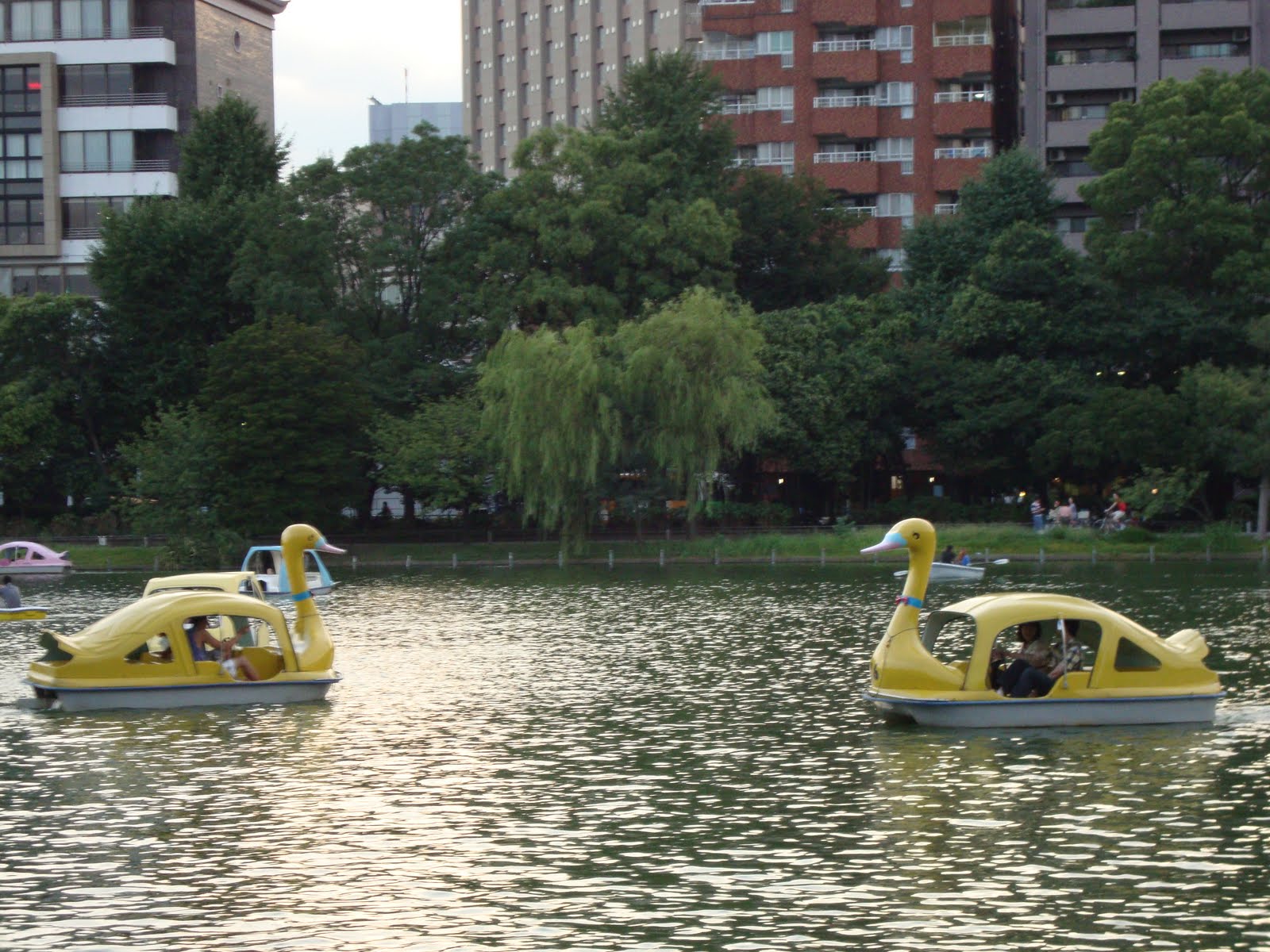
Swan Peddle boats

Traditional Japanese toilet in ladies room at Oeno Park--not it is essentially a hole in the floor.

Sunset over the pond


Lanterns lighting the way out

Close up of a lantern


Another shrine thing.

Video of Sam's school program

Those of you who have seen Sam in action in a school play/performance before will not be surprised by this one. His school participated in the 80th anniversary event for the Japanese school they share the school grounds with--Jinsho or Jingumae Elementary.  Here is Sam's role in that event.


Odds and Ends

I am not sure why, but often eggs come on top of whatever food you order. It doesn't really seem to matter what...pizza with a sunny side up egg on top, noodles with scrambled egg. Sid ordered a Caesar salad at one of the little Italian restaurants at Sunshine City (a chain called Italian Tomato Cafe Jr.) and it came with...that's right...eggs.  I am putting a picture below.